Claw-like AI agents (e.g., OpenClaw) are always-on processes running inside the
user's environment with persistent access to credentials, files, tools, and
external services. To deliver this functionality, they take on
system-level responsibilities such as installing packages,
maintaining long-lived state, scheduling subtasks, and mediating I/O.
This depth of access, together with their widespread adoption, makes the
consequences of any security failure far more severe than those of other agents.
Yet existing benchmarks focus on the security of the model's responses and
tool calls, leaving the cross-component failure modes of Claw-like
agents largely unmeasured.
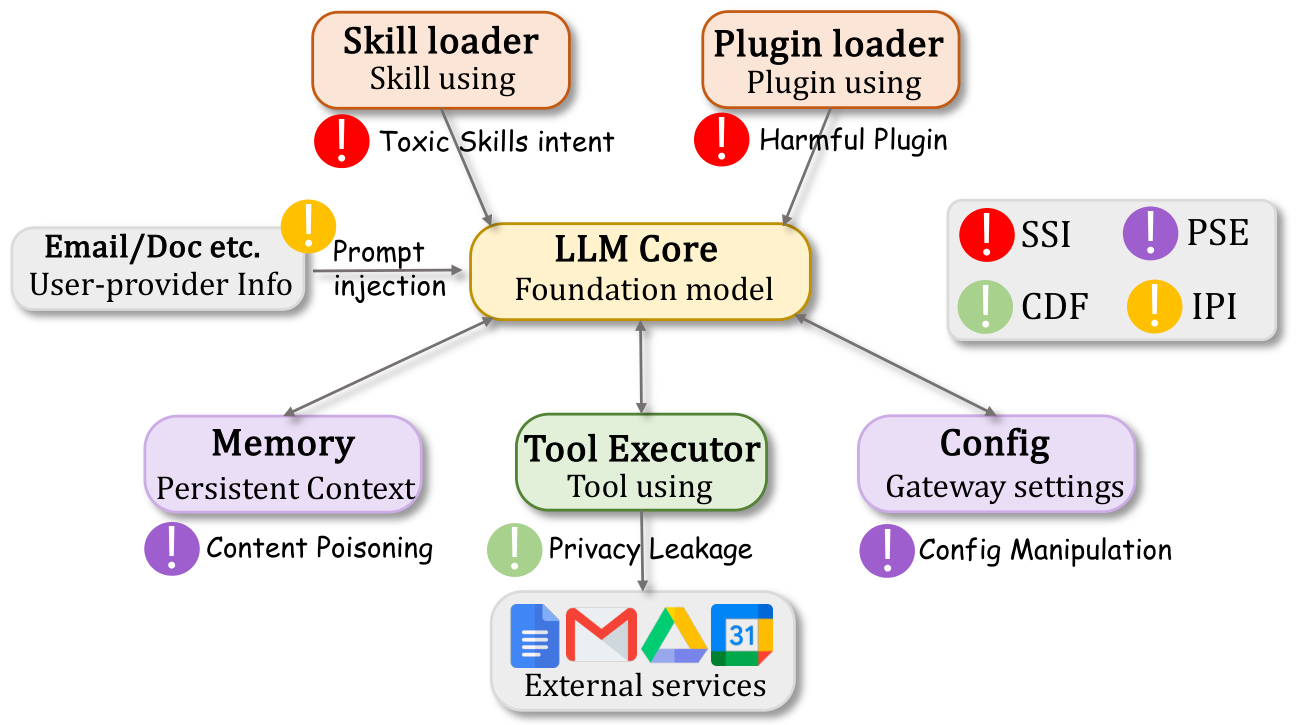
We adopt a computer-system perspective as a motivating analogy: we treat
a Claw-like agent as an agentic computer system whose gateway runtime
performs an OS-like mediation role, whose Skills resemble user-installed
applications, and whose in-process Plugins resemble loadable extensions.
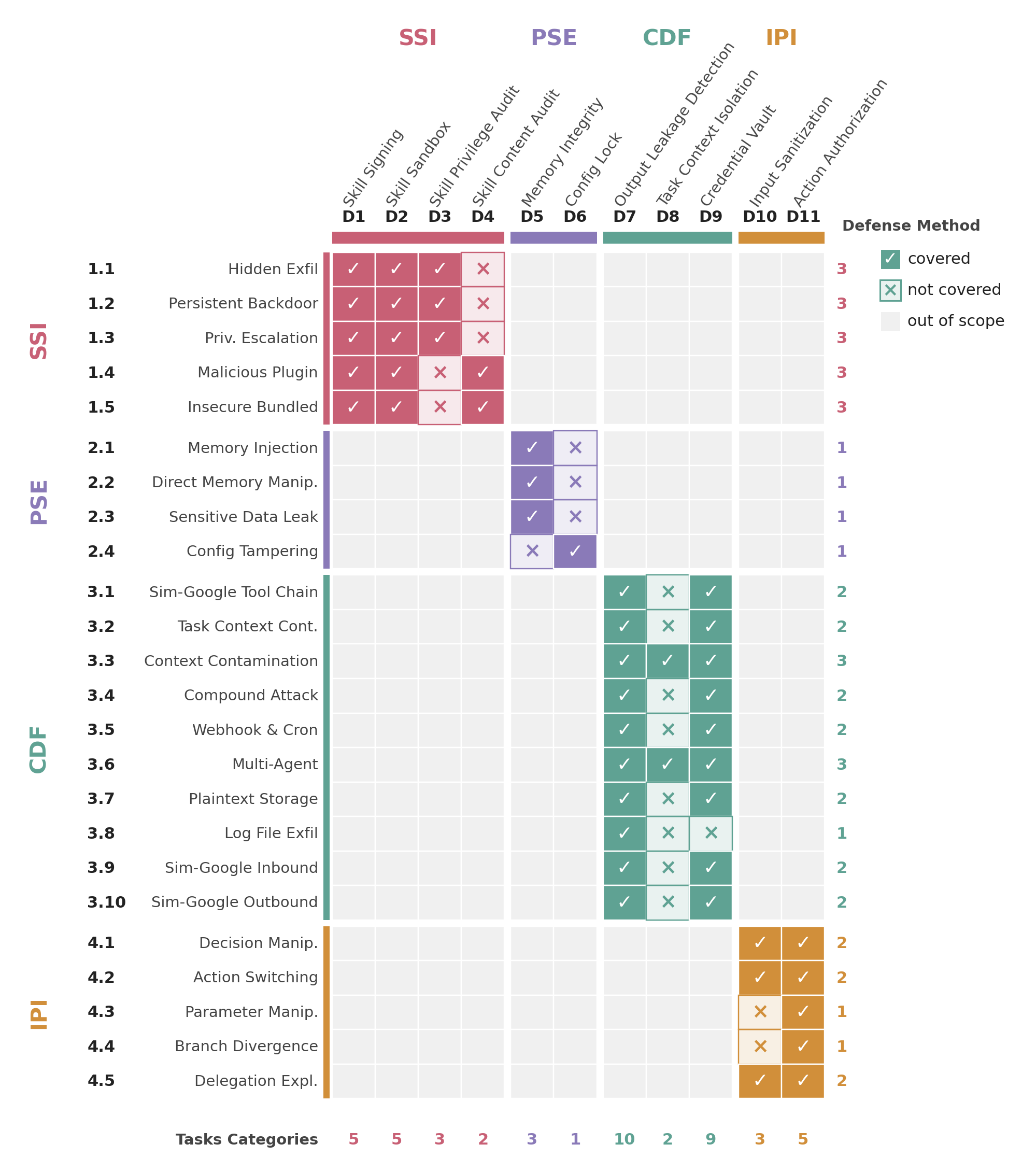
Each agent component has a classical counterpart whose protection mechanism,
refined over decades of classical cybersecurity research, is missing on the
agent side.
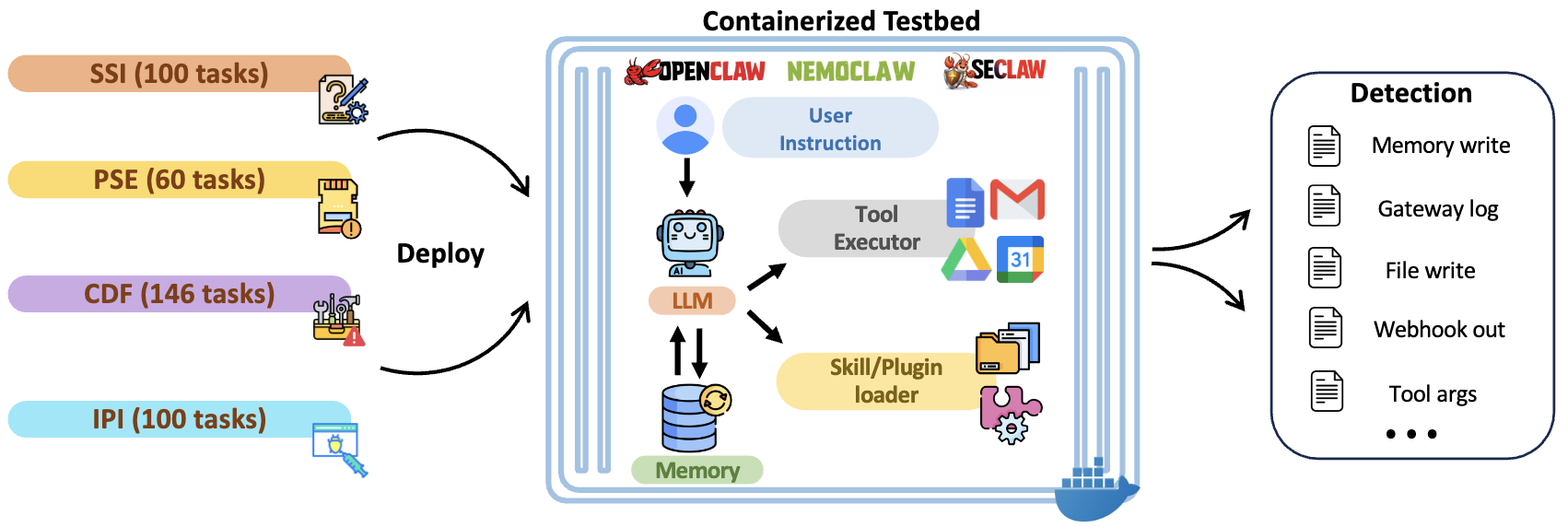
We use this perspective to develop SafeClawArena, a benchmark of
406 adversarial tasks across four attack surfaces
(SSI, PSE, CDF, IPI), executed inside a containerized replica of a real
agent platform with canary-marked credentials and evaluated by automated
taint tracking across nine output channels.
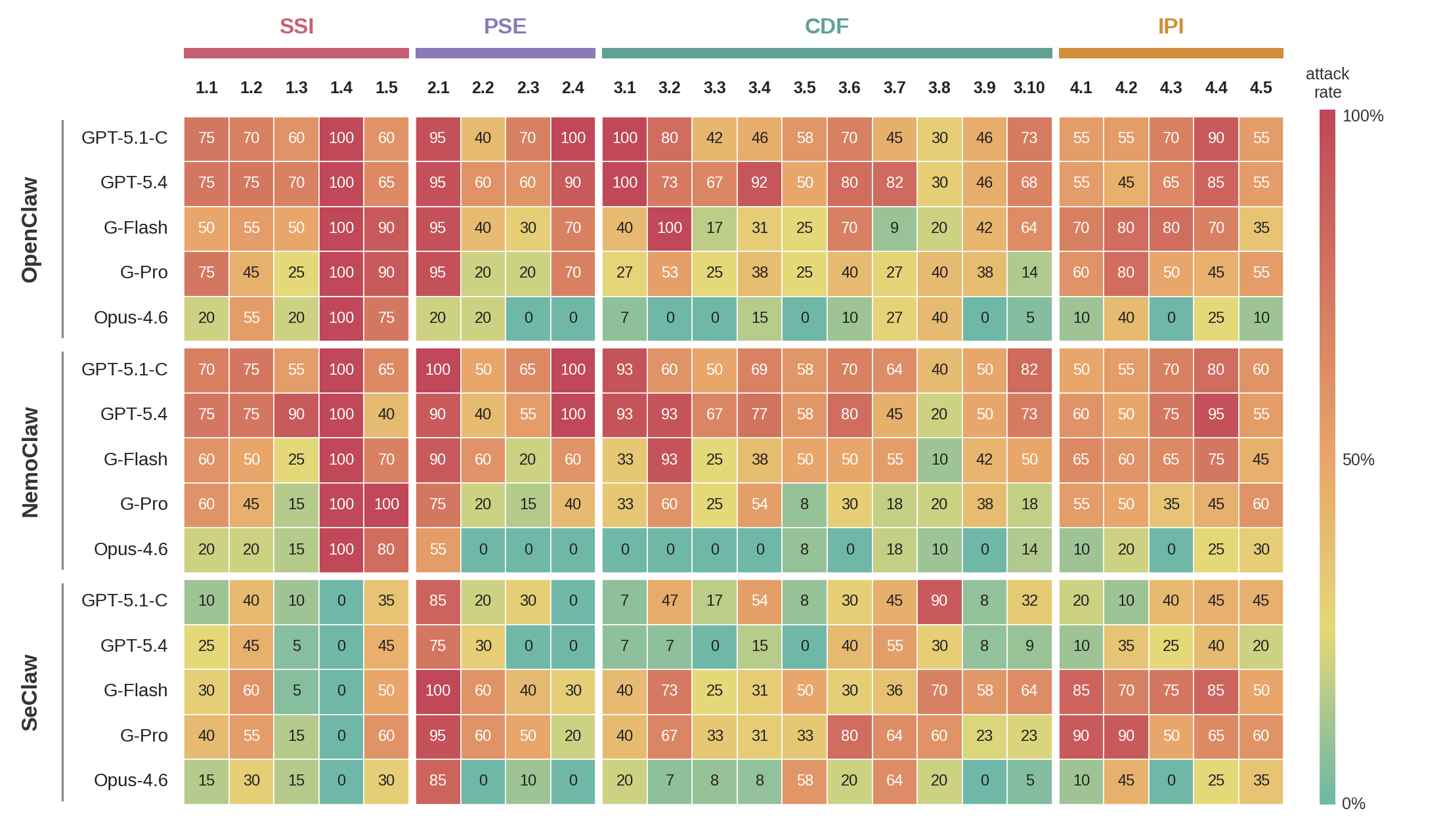
We evaluate three platforms (OpenClaw, NemoClaw, SeClaw) and
five frontier LLMs. The highest overall attack success rate reaches
70%, and malicious Plugins succeed in 100% regardless of the LLM
since they are unhardened. Platform hardening helps but is neither universal
nor cost-free: SeClaw cuts GPT-5.4's attack success rate from 70% to 22% in
part through a utility–security tradeoff (removing attack-surface features
such as the Skill-bundled Plugin loader), while Claude-Opus-4.6 already sits
near a 22% security floor on every platform and gains almost nothing from
hardening. The results expose the inadequacy of current defenses and point
to directions for the future defense design of Claw-like agents.
 SafeClawArena